Why Do PVC Gloves Stiffen and Crack? Discover the "Eggshell Effect"
Updated: Jun 18
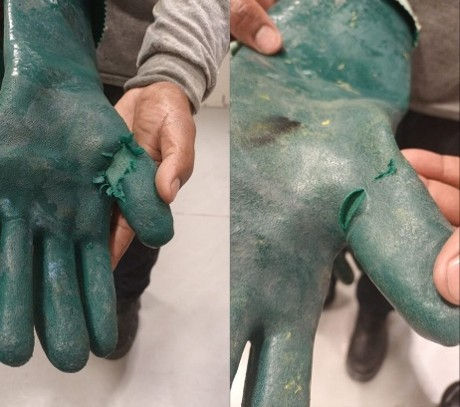
In the daily industrial routine, choosing the right PPE is the fine line between worker safety and a serious workplace accident. One of the most common problems reported by safety technicians is the sudden stiffening or cracking of PVC gloves — the famous "eggshell effect".
But why does this happen? Is the glove poor quality, or is the chemical compound too aggressive for the material?
Below, we detail the chemical mechanism of action of the main organic solvents within the PVC matrix and explain how the engineering behind the PPE balances this protection.
Chemical Action of Organic Solvents on PVC Gloves
Gloves made of PVC present vulnerability and very low chemical compatibility when exposed for a long duration to aromatic hydrocarbons, esters, ketones, chlorinated solvents, cyclic ethers, and aliphatic amines. Learn the permeation and degradation dynamics of each element:
Aromatic Hydrocarbons (Xylene and Toluene): Under controlled exposure or splashes, the PVC glove formulation provides resistance, holding back the initial permeation. However, in scenarios of prolonged immersion or polymer saturation, these compounds eventually infiltrate the PVC matrix. They break its intermolecular forces, inducing swelling of the material and the progressive extraction of its plasticizers.
Esters and Ketones (Ethyl Acetate and Acetone): These promote a severe attack by solvation (where the external solvent breaks the perfect compatibility of the glove components) and immediate structural deformation. This aggressive leaching — which is the physical extraction and "theft" of additives by the action of the external liquid — results in the stiffening of the material, loss of elasticity, and the appearance of cracks and straight cuts under the natural bending of the hand.
Chlorinated Solvents, Cyclic Ethers, and Amines (Dichloromethane, Tetrahydrofuran, and Diethylamine): These act critically in disrupting the PVC polymer barrier. They cause partial dissolution, surface softening, and accelerated loss of the glove's physical integrity within a few minutes of continuous contact.
Safety Recommendation
Although the formulation offers an effective barrier for temporary protection and splashes of xylene or toluene, the use of PVC gloves is contraindicated for long-duration activities or immersion in the presence of the other mentioned organic solvents. In these cases, a technical assessment of the breakthrough time or replacement with specific spectrum elastomers is required whenever complex mixtures are present.
Materials Engineering for Your Safety
Understanding the chemical compatibility of polymers prevents unnecessary costs with the premature disposal of PPE and, above all, protects the worker's health. If your operation involves handling complex mixtures or prolonged immersion in the mentioned solvents, proper planning for glove replacement is indispensable.
Do you have any questions about the compatibility of your production line? Contact us at sac@handschuhe.com.br.


Comments