
Chemical-Contaminated PVC Gloves: Understand Why They Are Class I Hazardous Waste
- HANDSCHUHE do Brasil
- 3 hours ago
- 3 min read
PVC (Polyvinyl Chloride) gloves are the frontline defense for thousands of industrial workers, offering excellent mechanical resistance and impermeability. However, when the workday ends, a critical challenge begins for the company's environmental management: correct disposal.
When a PVC glove comes into contact with hazardous chemicals, it ceases to be just a used piece of PPE (Personal Protective Equipment). It transforms into hazardous waste.
If you manage EHS (Environment, Health, and Safety) processes or want to ensure your factory is 100% compliant, this article details everything you need to know about risk classes, PVC reactions with different chemicals, and regulatory impacts.

1. Waste Classification: Why Are Used Gloves Class I?
In Brazil, solid waste classification is governed by the ABNT NBR 10004 standard. It divides materials into two major categories: Class I (Hazardous) and Class II (Non-Hazardous).
New PVC gloves or those used only for light mechanical protection (without chemical contact) could be classified as Class II. However, the scenario changes drastically after operational use:
Class I Waste (Hazardous): These are materials exhibiting characteristics of flammability, corrosivity, reactivity, toxicity, or pathogenicity.
The Sponge Effect: PVC gloves retain traces of the handled chemicals on their surface and often absorb them into their layers or inner cotton lining. For this reason, the glove assumes the risk classification of the most dangerous chemical it touched.
2. PVC Chemistry: How It Reacts with Acids and Solvents
PVC is a highly versatile polymer, but its degradation level and residue retention vary depending on the substance handled. Understanding this dynamic helps clarify the urgency of correct disposal:
Strong Acids and Bases (Corrosive)
The Reaction: PVC features excellent resistance to acids (such as hydrochloric or sulfuric) and bases (such as caustic soda). It does not dissolve easily in these substances.
The Disposal Danger: Although the glove remains intact, the acid gets impregnated into the outer surface and inner fabric. If disposed of incorrectly, this extreme acidity destroys soil microorganisms and contaminates groundwater sources.
Organic Solvents and Hydrocarbons (Flammable and Toxic)
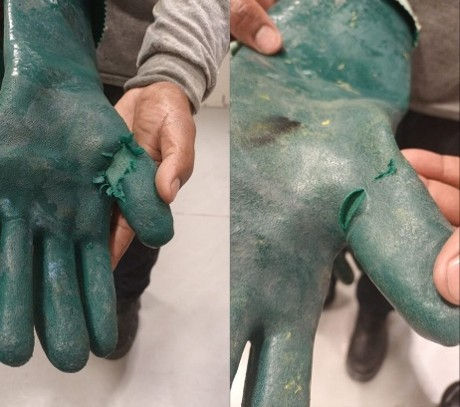
The Reaction: PVC is not recommended for prolonged contact with aromatic solvents (like xylene or toluene) and ketones (like acetone). These substances cause plasticizer leaching from the PVC, making the glove rigid, brittle, and permeable.
The Disposal Danger: Gloves that have been in contact with solvents become highly flammable. If thrown into regular trash, they can generate toxic vapors in the storage area or cause spontaneous fires in disposal bins.
3. Legal Impact: Fines and Penalties under National Policies
The incorrect disposal of contaminated Personal Protective Equipment is not just an operational failure; it is an environmental crime.
The National Solid Waste Policy (PNRS — Brazilian Law No. 12,305/10) establishes the principle of Shared Responsibility. This means the factory is legally liable for the waste from its generation to its final disposal ("cradle to grave").
The consequences of non-compliance include:
Heavy Fines: Financial penalties applied by environmental agencies can range from thousands to millions of Reais, depending on the volume and damage caused.
Civil and Criminal Liability: Directors and operations managers can be held criminally liable for environmental pollution (Environmental Crimes Law No. 9,605/98).
Loss of Certifications: Improper destination blocks the acquisition or renewal of crucial business reputation certifications, such as ISO 14001 (Environmental Management).
4. The Path to Safe Disposal: Where Should the Gloves Go?
For your factory to operate in full compliance and safety, the disposal flow must strictly follow these regulated paths:
Class I Industrial Landfills (Special Cells)
Unlike dumps or urban sanitary landfills (Class II), Class I Landfills are true environmental engineering works.
Gloves are deposited in trenches waterproofed with a double layer of HDPE (High-Density Polyethylene) geomembrane liners.
The system features continuous drainage of chemical leachate, which is directed to treatment, completely preventing the contaminated material from contacting the soil or groundwater table.
Co-processing in Cement Kilns
This is one of the most sustainable alternatives for industrial PVC.
Contaminated gloves are shredded and used as fuel substitutes in high-temperature kilns within the cement industry.
Due to the extreme heat (exceeding 1,400°C / 2,552°F), hazardous chemical molecules are completely destroyed.
Caution note: PVC co-processing requires strict volume control due to chlorine release, demanding specific filters in cement industries to neutralize gases.
Industrial Incineration
Recommended for gloves with a high level of contamination from ultra-toxic chemicals. The material is burned in controlled chambers, reducing waste volume to inert ashes, which then go to a Class I landfill. Emerging gases pass through modern scrubbers to prevent air pollution.
Conclusion: Safety Begins at Use and Ends at Disposal
Ensuring the correct disposal of PVC gloves goes far beyond avoiding fines. It is a practical demonstration of our factory's commitment to sustainability, the integrity of neighboring communities, and the protection of the professionals managing our waste.
Keep your team trained, bins labeled, and always demand the MTR (Waste Transport Manifest) and CDF (Final Disposal Certificate) from your environmental vendors.
Comments